Affiliate links may appear below. As an Amazon Associate I earn from qualifying purchases. General information, not medical advice.
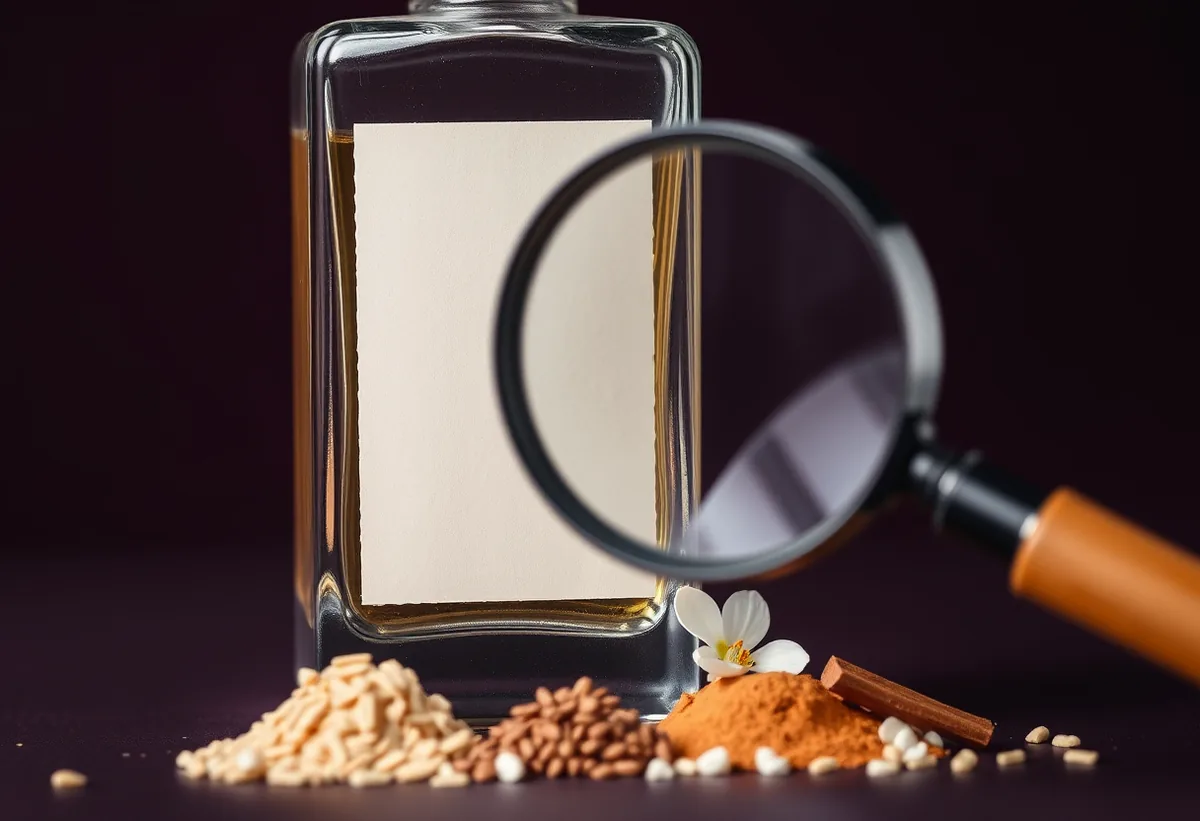
A fragrance box is a small piece of marketing wrapped around a smaller piece of regulation. The front tells you the name and a mood. The back, the base and the carton edges tell you the rest, if you know where to look. Here is how to read it.
The ingredient list and the word “fragrance”
Cosmetics sold at retail in the US carry an ingredient declaration. That is required under the Fair Packaging and Labeling Act. There is a catch. FDA notes that certain ingredients may be listed generally as “fragrance” or “perfume” without identifying the specific ingredients. The ingredient list on your bottle therefore usually reads something like Alcohol Denat., Parfum (Fragrance), Aqua, … and a few colorants or UV filters. The dozens or hundreds of compounds inside “parfum” are folded into one word.
That is a trade-secret convention, not a sign of anything shady. A fragrance formula is the product, and houses don’t publish it. But it does mean that if you react to a specific compound, you can’t confirm from the label whether it is in there.
The terms also appear in different forms. “Parfum” is the international (INCI) name for the fragrance mixture. “Fragrance” is the English form used on US products. They mean the same thing on a label.
Allergen declarations
In the EU, certain fragrance ingredients known to cause allergic reactions in some people must be named on the label when they exceed set thresholds. The European Commission listed 26 such substances in 2003, and a 2023 amendment added many more, as FDA’s allergen page summarizes. Common names you may see include Linalool, Limonene, Citronellol, Geraniol, Coumarin, Eugenol and Citral, often at the very end of the list.
Seeing these names isn’t a warning. They are ordinary components of many natural and synthetic materials, found in lavender, citrus peel, rose and more. They appear because they are common, not because the product is unusual. If you know you react to one of them, though, the list is useful, and it’s the reason EU-sourced packaging can tell a sensitive buyer more than a US bottle does.
US labels don’t require these individual declarations, so don’t assume an absence of names means an absence of the compounds.
“Unscented,” “fragrance-free,” “hypoallergenic”
FDA is direct on this: there is no federal standard or definition that governs the use of terms like “hypoallergenic,” “fragrance-free” or “for sensitive skin” in the US. It also notes that “unscented” products may contain fragrance ingredients added to mask other smells. If avoiding fragrance matters to you, read the ingredient list rather than trusting the claim, and watch for “parfum,” “fragrance,” essential oils and botanical extracts.
Concentration names
“Eau de parfum,” “eau de toilette,” “cologne” and the rest are conventions that indicate roughly how much fragrance oil is in the bottle, not legally defined grades. We break down the usual ranges in EDP vs EDT vs cologne. Terms like “intense,” “absolute” or “elixir” are brand names for a variation and aren’t standardized. Don’t treat them as a measurement.
Volume, origin and the small print
- Volume. Shown in milliliters and fluid ounces. Compare per-wear value by how much you’ll realistically use, not by the number.
- Made in / distributed by. Gives a manufacturer or importer you can contact. Contact details are worth having if you have a question or a reaction.
- Warnings. Often “flammable,” “keep away from eyes,” “for external use only.” Alcohol-based fragrance is flammable, so don’t spray near flames or hot surfaces.
- Marketing language. “Clean,” “natural,” “safe” and “non-toxic” aren’t defined terms for fragrance. Natural is not automatically gentle either, since essential oils are a common source of allergens.
Dates, batch codes and the open-jar symbol
Most bottles carry a batch code, a short string of letters and numbers on the base or the carton. It identifies the production run, and it’s useful for checking whether a bottle is recent and for reporting a problem to the maker. Decoders exist online for popular brands, and accuracy varies.
Some products also carry a period-after-opening symbol, a small open jar with a number and the letter M, indicating how many months the product is intended to be good after you first open it. Fragrance often omits it, because alcohol-based perfume is slow to spoil. When a date or symbol is printed, treat it as guidance. How you keep the bottle matters more, as we explain in how to store fragrance.
If you’re buying from a third-party seller, a missing batch code, a code that’s been scratched off, or a box that doesn’t match the bottle are reasons to be cautious. They don’t prove anything on their own.
Reading pheromone claims
Some products carry statements such as “contains pheromones” or name compounds like androstenone, androstadienone or estratetraenol. Here is how to read them.
- It’s the maker’s statement. Treat it as “the maker says,” not a verified fact.
- It names an ingredient, not an effect. A listed compound tells you what the maker says is inside. It doesn’t establish that the compound does anything to other people.
- The science is unsettled. In a 2015 review in Proceedings of the Royal Society B, Tristram Wyatt concluded that humans may well have pheromones but that there is no robust bioassay-led evidence for the widely published claims that those four steroids are human pheromones. No human pheromone has been conclusively identified.
- Look at the verbs. “Formulated with,” “contains” and “scented with” are descriptions. “Attracts,” “makes people want you” and “works on others” are claims of effect, which this site doesn’t endorse. We explain why in scent etiquette and consent.
- Quantities are usually not disclosed. If the label doesn’t say how much is present, you can’t evaluate the claim.
A sound way to buy these products is the same as any other fragrance: because you like how they smell.
Before you wear it
If you’ve never used a product, test a small amount on a patch of skin first. The American Academy of Dermatology suggests applying a quarter-sized spot, such as the inner forearm, and watching for redness, itching or swelling over several days. Read more in our patch testing guide.
A one-minute label check
- Is the name of the maker and a contact printed?
- What does the ingredient list say, and does “parfum” matter to you?
- Are allergen names declared, and are any ones you avoid?
- Is the concentration stated, and does it suit where you’ll wear it?
- Is there a batch code that matches the box and bottle?
- Do any claims describe an effect on other people? If so, read them as marketing.
Questions
Why does the ingredient list just say 'parfum' or 'fragrance'?
In the US, FDA notes that certain ingredients can be listed generally as 'fragrance' or 'perfume' without naming each component. It protects formulas but means you often cannot see which compounds you are exposed to.
What are the EU fragrance allergens?
A list of specific fragrance ingredients that must be declared by name on EU cosmetic products above set thresholds. It was a list of 26 substances from 2003 and was expanded by a 2023 amendment.
Does 'unscented' or 'hypoallergenic' mean fragrance-free?
No. FDA says there is no federal standard defining 'hypoallergenic' or 'fragrance-free' in the US, and some products labeled unscented contain fragrance ingredients used to mask odors.
What does a pheromone claim on a label mean?
It is a statement by the maker. Researchers have not conclusively identified a human pheromone, so treat any claim of effect as the seller's, not an established fact.
Sources
As an Amazon Associate I earn from qualifying purchases. How we pick.