Affiliate links may appear below. As an Amazon Associate I earn from qualifying purchases. General information, not medical advice.
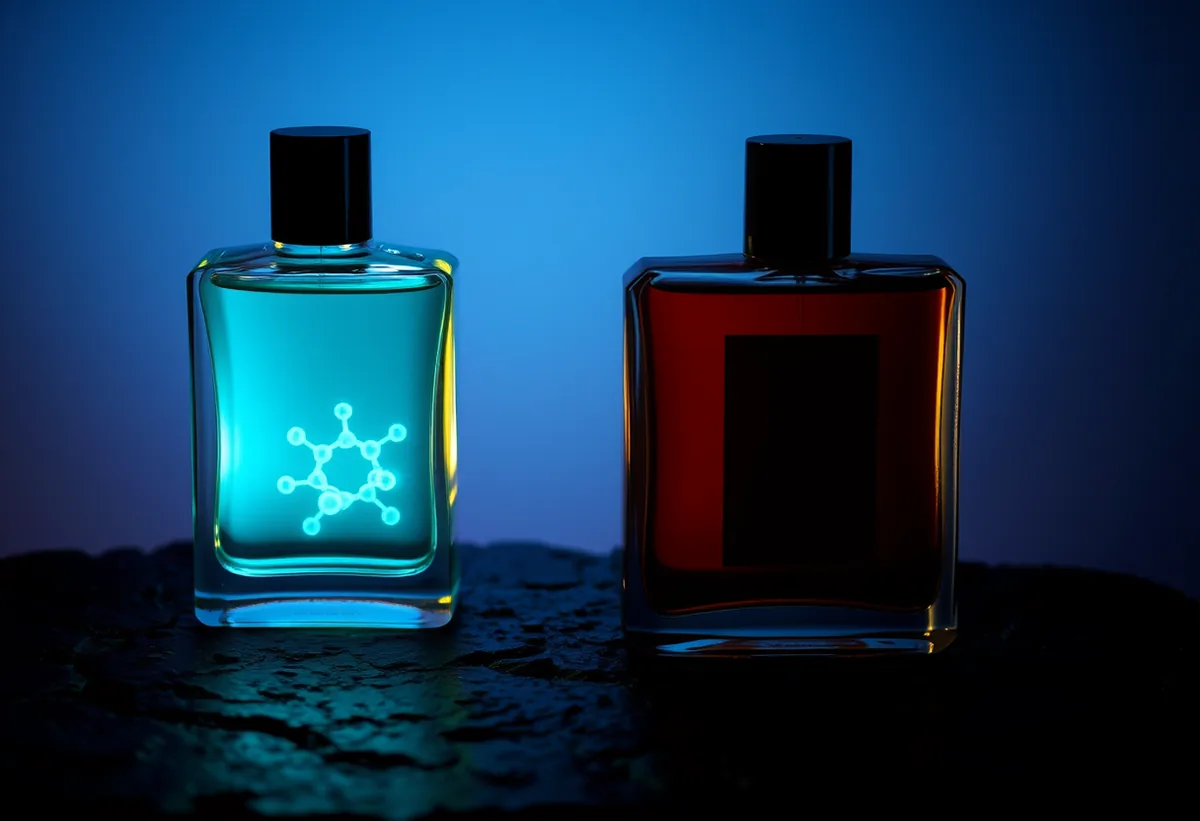
Put a pheromone cologne next to a regular one on a counter and, with the labels covered, you’d struggle to tell which was which. That’s the most useful thing to know. The difference is mostly in the description, not the liquid.
What a regular cologne is
A cologne, in everyday shopping language, is a fragrance built from aromatic oils dissolved in alcohol, sometimes with a little water. The oils come from natural extracts and synthetic aroma molecules, arranged in layers: top notes that you smell first and that fade fast (citrus, herbs), heart notes that carry the middle hours (florals, spices, aromatic woods), and base notes that linger (amber, musks, woods, vanilla).
The word “cologne” is used loosely. Traditionally it meant a light, low-concentration splash. In the US it now commonly just means a men’s fragrance, regardless of strength. We cover strength and wear in how to apply cologne and perfume. For this comparison, assume both products are ordinary fragrances in alcohol.
What a pheromone cologne is
A pheromone cologne is a fragrance that also includes one or more synthetic compounds the manufacturer sells as pheromones. The usual suspects are androstenone, androstadienone, and sometimes estratetraenol or copulins. Some products add them to a conventional scent. Others sell the compound in a mostly unscented carrier you mix with your own fragrance. The packaging commonly suggests that the compound will change how others respond to you.
That suggestion is where the two product types actually part ways. A regular cologne says “this smells like cedar and bergamot.” A pheromone cologne says “this smells like cedar and bergamot, and also here’s a molecule.”
What the added compound gets you
Here we stay with the research. A 2015 review by Tristram Wyatt in Proceedings of the Royal Society B found no robust evidence that any of the four candidate steroids is a human pheromone. He identifies the usual problems: small samples, overestimated effects, publication bias, and a lack of replication. A 2010 review of the androstenes by Havlicek and colleagues described a similarly inconsistent literature, and Richard Doty’s book The Great Pheromone Myth argues the case more sharply still.
There are lab results worth acknowledging. Hummer and McClintock reported in 2009 that androstadienone seemed to direct attention toward emotional information in participants. That’s a small, specific finding, and it is not the same thing as “makes you more attractive.”
Two further points matter when you’re comparing products.
First, the dose. In a lab, researchers use controlled amounts in controlled settings. A commercial fragrance has an unknown concentration of the compound, applied by you in an unknown amount, in a bar or an office or an elevator. Nothing about that resembles an experiment.
Second, the smell of the compound itself. Androstenone is perceived very differently from person to person: some smell nothing, some smell sweat or urine, some smell something sweet or woody. Someone who dislikes it will dislike your cologne. This is one real, practical way a pheromone cologne can differ from a regular one, and it’s a reason to sample first.
Side by side
| Regular cologne | Pheromone cologne | |
|---|---|---|
| Core product | Fragrance oils in alcohol | Fragrance oils in alcohol plus a marketed compound |
| Main selling point | Scent and wear | Scent plus an implied effect |
| Evidence for the extra ingredient | Not applicable | Mixed to weak; no human pheromone conclusively identified |
| Ingredient transparency | Usually a standard ingredient list | Varies; some name the compound, some don’t |
| What you can verify | Smell, longevity, projection | The same things, and nothing more |
Why the labels are so confident
A fragrance is regulated as a cosmetic in most places, and cosmetic marketing leans on feeling rather than measured outcomes. That is why a regular cologne can say “magnetic” without anyone asking for data, and why a pheromone cologne can get away with a more specific suggestion. The wording is usually careful enough to describe the formula rather than promise a result, so the implication does the work the sentence avoids.
Read listings the way you’d read a menu description. “Hand-cut” and “farm-fresh” tell you about the pitch. Ingredients and how it tastes tell you about the dish.
How the claims differ
Regular colognes sell mood: “fresh,” “dark,” “clean.” They’re subjective and nobody expects a lab report.
Pheromone products sell outcomes, and that’s where to be careful. Phrases to treat as warning signs:
- Anything promising to attract, control, or influence people.
- “Clinically proven” with no named study.
- “Works on everyone.”
- Testimonials standing in for evidence.
Attributed language is fine and clear: “the maker says it contains androstenone” or “marketed as a pheromone fragrance.” We use that wording on every pick for a reason. We describe the claim; we don’t confirm it.
A word on “unscented” pheromone products
Some pheromone products are sold as an oil or spray with little or no fragrance, meant to be worn alone or under a regular cologne. The logic is simple: you pick the scent, the bottle supplies the added compound. In practice you are buying the unproven part on its own, with nothing to enjoy if the claim turns out to be hollow. If you want to experiment, a fragrance-forward product gives you something certain for your money.
Which one should you buy?
If you’re shopping on scent alone, regular cologne opens up a far bigger range, since the pheromone category is a niche within it. If the idea of the added compound intrigues you, there’s no harm in trying one, provided you treat it as a fragrance purchase.
A sensible way to decide:
- Smell comes first. If you wouldn’t buy it without the pheromone pitch, don’t buy it with.
- Check that the maker names the compound and the product page states claims as claims.
- Sample if you can. Wear it for a full day. Many fragrances smell different after three hours than they do in the first thirty seconds.
- Skip anything that promises results from other people.
And remember what scent is for. It’s one of the few things you can wear that other people experience only if they’re close to you. That makes it a good tool for self-expression and a poor one for steering anyone. Wearing a fragrance you love and sharing it with people who are already glad to be near you is the whole point.
The useful summary
A pheromone cologne is a regular cologne with an extra ingredient and a bolder sales pitch. The ingredient is unproven. The pitch is not evidence. The scent is yours to judge, and that’s the only part you can fully verify at home.
Questions
What is the difference between pheromone cologne and regular cologne?
A pheromone cologne is a fragrance with one or more added synthetic compounds that the maker markets as pheromones. A regular cologne is the same kind of product without that ingredient or that pitch.
Does pheromone cologne smell different?
It can, but not because of the pheromone. The added compounds are used in small amounts, and many products are scented to resemble conventional colognes. Some people notice a faint musky or sweaty nuance from androstenone-type compounds.
Is pheromone cologne better than regular cologne?
There is no good evidence that it is. Human pheromones have not been conclusively identified, so the extra ingredient should be treated as unproven. Judge it by scent, longevity and how it feels on you.
How can I tell what is in a pheromone cologne?
Look for the maker's ingredient disclosure or the claimed compound, such as androstenone or androstadienone. If the listing names no ingredient at all, that is a reason for caution.
Sources
- Wyatt TD (2015). The search for human pheromones: the lost decades and the necessity of returning to first principles. Proc R Soc B 282:20142994
- Havlicek J et al. (2010). Current issues in the study of androstenes in human chemosignaling. Vitam Horm 83:47-81
- Hummer TA, McClintock MK (2009). Putative human pheromone androstadienone attunes the mind specifically to emotional information. Horm Behav 55:548-559
- Doty RL (2010). The Great Pheromone Myth. Johns Hopkins University Press
As an Amazon Associate I earn from qualifying purchases. How we pick.